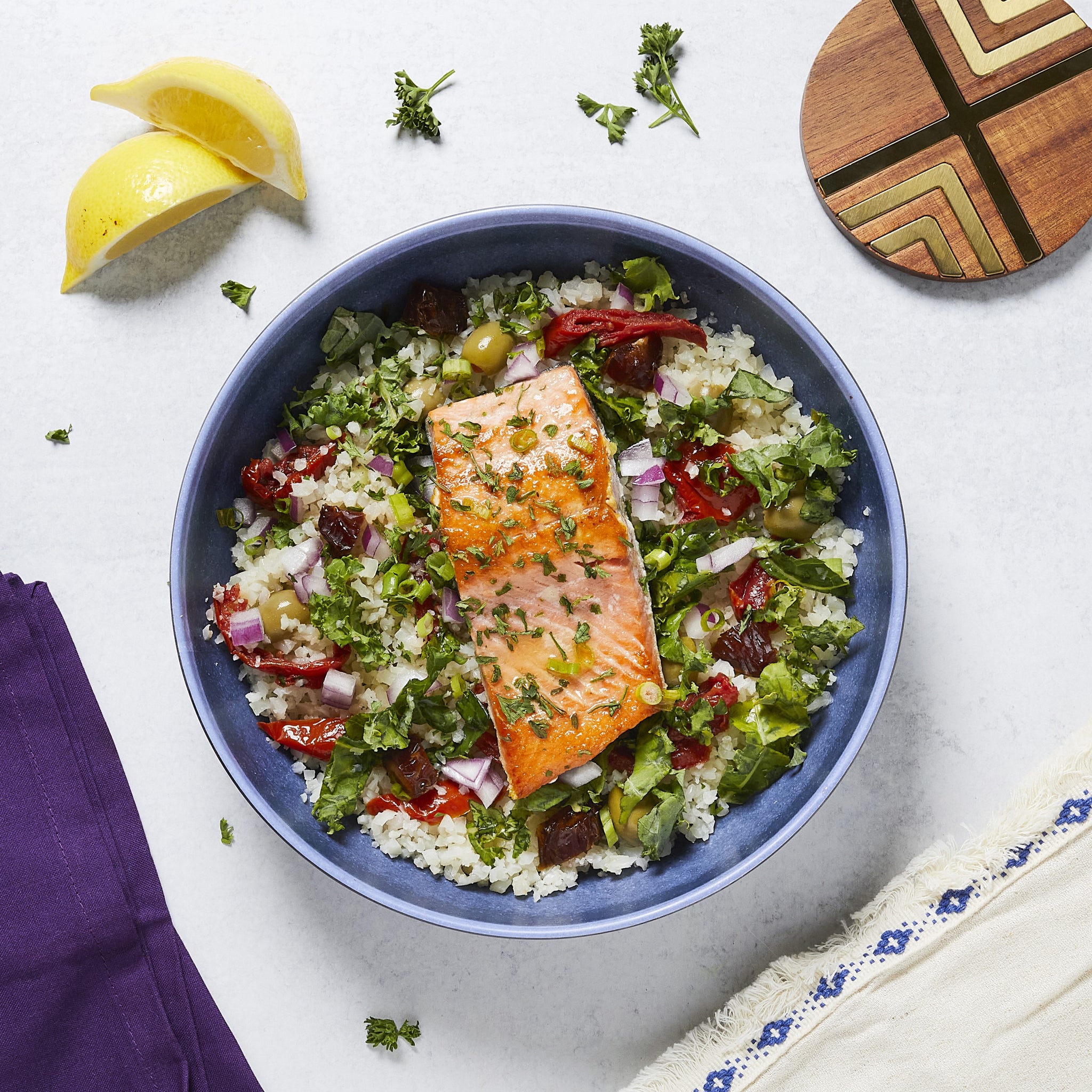

Two hours, one person, a whole week of food
You already know Sunday meal prep works. The part nobody hands you is a real timeline: what actually goes in the oven, in what order, and how long before you can sit down again.
So here it is. A start-to-finish blueprint for one person, built for one Sunday afternoon, roughly two hours of active work. Five things go in the oven. Two things get assembled cold. One grocery list feeds all of it. No fantasy meal prep schedule where everything magically finishes at once, and no pretending the dishes clean themselves. Let's run the clock.
The one-person shopping list
The best weekly meal prep ideas start at the store. Everything below feeds one person for about five to seven dinners, plus breakfasts and a couple of lunches. Buy it Saturday if you can, so Sunday is pure cooking.
Proteins
-
2 lbs boneless, skinless chicken breast
-
2 salmon fillets (about 12 oz total)
-
1 block firm tofu or 1 can chickpeas, if you want a meatless day
-
1 dozen eggs
Produce and grains
-
3 medium sweet potatoes
-
2 heads broccoli
-
2 bell peppers, 1 zucchini, 1 red onion
-
1 bag baby spinach
-
1 cup dry rice or quinoa
-
1 cup rolled oats
-
Berries or a banana for the oats
Pantry and dairy
-
Olive oil, salt, pepper, garlic powder, paprika, your favorite spice blend
-
Greek yogurt or milk of choice
-
Chia seeds (optional, for thicker oats)
That's the whole cart. Roughly a quarter of your plate as protein, a quarter as grain, and half as vegetables, which lines up neatly with the balanced-plate proportions USDA recommends on MyPlate. Nothing here is fussy, and most of it is nutrient-dense enough to carry the week.
0:00 to 0:15 Pull the list and preheat
First fifteen minutes, no cooking yet. This is setup, and skipping it is exactly why prep runs long.
-
Set the oven to 425°F. It needs time to reach temperature while you work.
-
Line two or three sheet pans with parchment or foil. Future-you cleaning up will be grateful.
-
Pull out every container you plan to fill and count them. Short on lids? Better to know now than at 1:45. If your set is a mismatched drawer of takeout tubs, a matching stack genuinely changes the experience, and the right containers make portioning easier.
-
Rinse produce, pat the chicken and salmon dry, and start your rice or quinoa on the stove now so it cooks hands-off.
Clock's running. Oven's heating. Let's load it.
0:15 to 0:45 Everything into the oven
This stretch is the engine of the whole afternoon. Here are the five things that go in the oven, in the order they should hit the racks.
-
Sweet potatoes first. Scrub, prick with a fork, and roast whole. They take the longest, about 45 minutes, so they lead.
-
Chicken breast on a lined pan. Toss with olive oil, salt, pepper, garlic powder, and paprika. Roughly 22 to 26 minutes at 425°F.
-
Salmon fillets on their own pan. Olive oil, salt, a squeeze of lemon if you have it. Just 12 to 15 minutes, so these go in later.
-
Roasted vegetables: peppers, zucchini, and red onion, oiled and salted on a sheet pan. About 25 minutes, tossed once.
-
Egg muffin cups for grab-and-go breakfast. Whisk 8 eggs, stir in chopped spinach, pour into a muffin tin, bake 18 to 20 minutes.
Stagger them so nothing crowds. Two racks, rotate as space frees up. The chicken and eggs can share the oven; salmon slides in once the potatoes are halfway done.
0:45 to 1:00 Build the two cold dishes
While the oven does the heavy lifting, put together the two things that get assembled cold. No heat, no timer, just layering.
-
Overnight oats. In two jars, combine 1/2 cup oats, 1/2 cup milk or yogurt, a spoon of chia, and berries. Lid on, into the fridge. Breakfast for two mornings, done. When the dedicated breakfast guide publishes, we'll link it right here.
-
A cold grain-and-greens bowl. Spinach base, cooked chickpeas or reserved rice, chopped raw pepper, a drizzle of olive oil. This is your no-reheat lunch for a busy day.
Cold builds are where a hard week gets easier. If you want a deeper bench of options, our roundup of make-ahead lunch and dinner ideas for the week has plenty that hold up in the fridge.
1:00 to 1:30 Flip, rotate, and check temps
The middle stretch is management, not chaos. Pull the salmon and eggs as they finish, flip the veggies, and start checking doneness.
Grab an instant-read thermometer here. Chicken is safe at 165°F, salmon at 145°F. Guessing is how you end up with dry chicken or an anxious Tuesday.
The oven does the cooking. You're just the traffic controller, moving pans in and out and reading temperatures.
As each tray finishes, set it on the counter to cool slightly before it goes anywhere near a lid. Sealing hot food traps steam, and steam is the enemy of texture and shelf life.
1:30 to 2:00 Portion, cool, and label
The home stretch. Everything's cooked. Now it becomes actual meals.
-
Slice the chicken, flake the salmon, and split the sweet potatoes.
-
Build each dinner container: a palm of protein, a fist of grain or potato, and the rest vegetables. Repeat until the trays are empty.
-
Cool food to room temperature, then refrigerate within two hours of cooking, per federal food-safety guidance. Cooked chicken and salmon keep three to four days in the fridge, which the official cold food storage chart from FoodSafety.gov lays out clearly.
-
Label anything you're freezing with the date. A fridge thermometer set to 40°F or below is worth the few dollars, and the FDA explains why that temperature matters.
Want your meals to still taste good on day four? Our guide to keeping prepped food fresh all week covers the storage tricks that protect flavor and texture. The full freezer breakdown is coming soon, and it'll live here too.
Can you meal prep on Sunday for the whole week?
Short answer: yes, with one honest caveat. Cooked proteins and most roasted vegetables are at their best for three to four days in the fridge, so a single Sunday session comfortably covers Monday through Thursday.
For Friday, Saturday, and Sunday, you have two easy moves:
-
Freeze half the batch on Sunday and thaw it midweek.
-
Or do a quick 20-minute top-up on Wednesday for the back half of the week.
So one Sunday can absolutely fuel a full week of food. Real meal prep for the week just means splitting it between the fridge and the freezer instead of asking day-seven chicken to taste like day one.
What is the 3-3-3 rule for meal prep?
The 3-3-3 rule is a simple framework for keeping a week of meals varied without cooking a dozen different recipes. You prep:
-
3 proteins (say, chicken, salmon, and chickpeas)
-
3 vegetables or sides (broccoli, roasted peppers, spinach)
-
3 carbs (sweet potato, rice, oats)
Mix and match, and those nine components become far more than nine meals. It's one of the simplest week meal prep ideas going, and it's exactly why the blueprint above leans on a handful of flexible building blocks rather than five rigid, single-use recipes.
Why two hours quietly becomes four
Let's be candid, because pretending otherwise helps no one. The cook time is two hours. The Sunday can still eat four. Here's where the extra time hides.
-
The dishes. Every pan, bowl, and cutting board lands in the sink at once. Wash as you go during the oven's idle stretches, or the cleanup alone adds 30 to 45 minutes.
-
The unplanned grocery run. You're out of olive oil, or the store had no salmon. One forgotten item becomes a 40-minute round trip. This is why Saturday shopping earns its keep.
-
The recipe that needed a pan you don't own. Muffin tin buried, only one sheet pan, no lid that fits. Suddenly you're baking in shifts. Counting your gear in that first 15 minutes is what prevents this.
None of this means the system is broken. It means the real cost of a from-scratch Sunday is closer to two hours plus a load of dishes and the occasional supply hiccup. If your Sundays are already stretched thin, our tips for meal prepping when you're genuinely short on time trim the plan down further.
The honest math of a prepped week
Here's the mindset shift: Sunday meal prep isn't a life hack that gives you free food. It's a trade. Two focused hours on Sunday buys you a week of not deciding, not scrambling, not ordering takeout at 8 p.m. because the fridge is empty.
Most weeks, that trade is well worth making, and the blueprint above is designed to keep your side of it as small as possible. Prep flexible building blocks, respect the storage timelines, and let the oven carry the load while you handle the cold builds and the cleanup.
Consistency is what turns one good Sunday into a habit. Some weeks you'll nail the two hours. Some weeks life will win. Both are fine.
For the weeks you can't spare the two hours
And on the weeks you don't want to pay the two-hour cost? That's exactly what we're here for. When Sunday meal prep just isn't happening, you can hand it off and let our chef-prepared meal prep service deliver the balanced, nutrient-dense meals you'd have cooked yourself. Prep it when you can. Order it when you can't. Either way, you eat well.